


What if the thoughts you think and the emotions you practice each day were shaping your reality more than you realize?
Most of us were raised to see ourselves as physical beings moving through a physical world, responding to events as they unfold and doing our best to manage whatever circumstances life places before us. We’re taught to trust what can be touched, measured, counted, or explained.
Yet there is another way to understand our existence, one that feels both ancient and quietly intuitive. It suggests that we are not merely bodies reacting to events, but fields of energy continuously interacting with other fields of energy.
Within that perspective, our thoughts, emotions, beliefs, and internal states are not sealed off from the world around us. They move through the nervous system, influence the chemistry of the body, shape our perception, and subtly radiate outward into our relationships and experiences. In ways both visible and invisible, we are constantly transmitting and receiving signals.
This realization changes more than it may first appear to.
If the quality of our inner world is not passive but participatory, then the emotional atmosphere we live within each day begins to matter deeply. Whether we notice it or not, we are continuously broadcasting a signal shaped by our dominant emotional patterns, our expectations, our wounds, our hopes, and our level of inner peace.
That signal influences how we interpret events, how we respond to them, and how others experience us in return.
Life does not simply happen to us. We are in an ongoing relationship with it, and the frequency of our inner world plays a powerful role in shaping that relationship.
The Frequency of Emotion
The idea that emotions carry energetic qualities is not new. Across centuries and cultures, people have observed that some emotional states feel dense and constricting, while others feel open and expansive.
Fear tightens the body and narrows our sense of possibility. Shame contracts not only our self-image but also our imagination. Anxiety can make the world feel smaller, reducing life to threat, urgency, and survival.
Yet emotions such as courage, gratitude, compassion, and love create a very different experience within us. They soften the body, widen perception, and allow the nervous system to settle into a more receptive state.
These emotions do more than feel pleasant. They shift the conditions under which we think, choose, connect, and create.
In that sense, emotion is not simply something we feel. It is also a state we practice.
The emotions we return to most often gradually become familiar terrain. Over time they establish our emotional baseline. A person who has lived for years with constant worry may begin to interpret anxiety as vigilance or responsibility. Someone who has grown accustomed to disappointment may mistake resignation for realism.
Patterns that once developed as protection can slowly become identity if they are left unexamined.
But these patterns are not the deepest truth of who we are. They are habits—and habits can change.
Courage: The Turning Point
One of the most important thresholds in this process is courage.
Courage is often misunderstood as fearlessness. In reality, it is something much more human and accessible. Courage is the willingness to move forward while fear is still present. It is the moment when our old patterns stop being the only voice guiding our decisions.
This is why courage feels so powerful.
It marks the point where we stop living entirely in reaction to life and begin participating in it more consciously. Even small acts of courage can begin to shift the emotional atmosphere of our lives.
When this happens, daily life begins to feel different. Challenges may still arise, but clarity increases. Our perception widens. Energy that once remained trapped in defensive habits becomes available for creativity, insight, and meaningful action.
Why the World Feels So Out of Balance
When we look at the world today, it becomes easier to see how emotional states can shape collective reality.
Many people are moving through life in a state of chronic exhaustion, stress, or emotional depletion. Despite unprecedented technological connection, many feel increasingly disconnected from themselves and from one another. Stress and overwhelm have quietly become normalized.
Given this reality, it is not surprising that so much of modern life feels unsettled.
Our collective experience is not shaped only by institutions or social systems. It is also influenced by the combined emotional atmosphere created by millions of individuals living with fear, anger, grief, urgency, and uncertainty.
The private state of the nervous system does not remain private for long. The emotions we repeatedly live in begin to appear in our homes, our conversations, our communities, and our culture.
Fortunately, the opposite dynamic is also true.
Just as fear can spread quickly, so can calm. Just as anxiety ripples outward, so can steadiness and peace.
Most of us have felt this before. We have entered a room where tension seemed to vibrate in the air before anyone spoke. And we have also encountered people whose presence alone made the environment feel calmer.
Energy, in this sense, is contagious.
Which means that personal growth is never only personal. When we cultivate greater coherence within ourselves, we inevitably influence the atmosphere around us.
Raising Your Vibration Is Not About Pretending to Be Positive
One of the most common misunderstandings about raising your vibration is the belief that it requires forcing yourself into positive emotions.
Real transformation rarely works that way.
It usually begins by removing the conditions that keep us stuck in contraction. Emotional triggers left unresolved, constant stress, endless digital stimulation, and chronic negativity can slowly drain the nervous system and keep us operating from a lower emotional baseline.
Much of what we call “low vibration” is not a personal failing but the accumulation of unprocessed tension within the body and mind.
Over time this tension narrows our perception and convinces us that living in a contracted emotional state is simply normal.
But when we begin to release some of these pressures—when emotions are acknowledged rather than avoided, when we reduce the constant agitation of screens and media, and when we allow space for rest and reflection—something remarkable begins to occur.
The body begins to remember what it feels like to exist without constant defense.
And in that release, higher emotional states often arise naturally.
Calm begins to appear where anxiety once dominated. Curiosity replaces cynicism. Compassion grows where judgment once lived.
These shifts do not usually arrive through force. They appear gradually, much like clear water emerging as sediment slowly settles to the bottom of a glass.
In this way, raising your vibration is less about becoming someone new and more about rediscovering who you have always been beneath layers of noise, stress, and emotional residue.
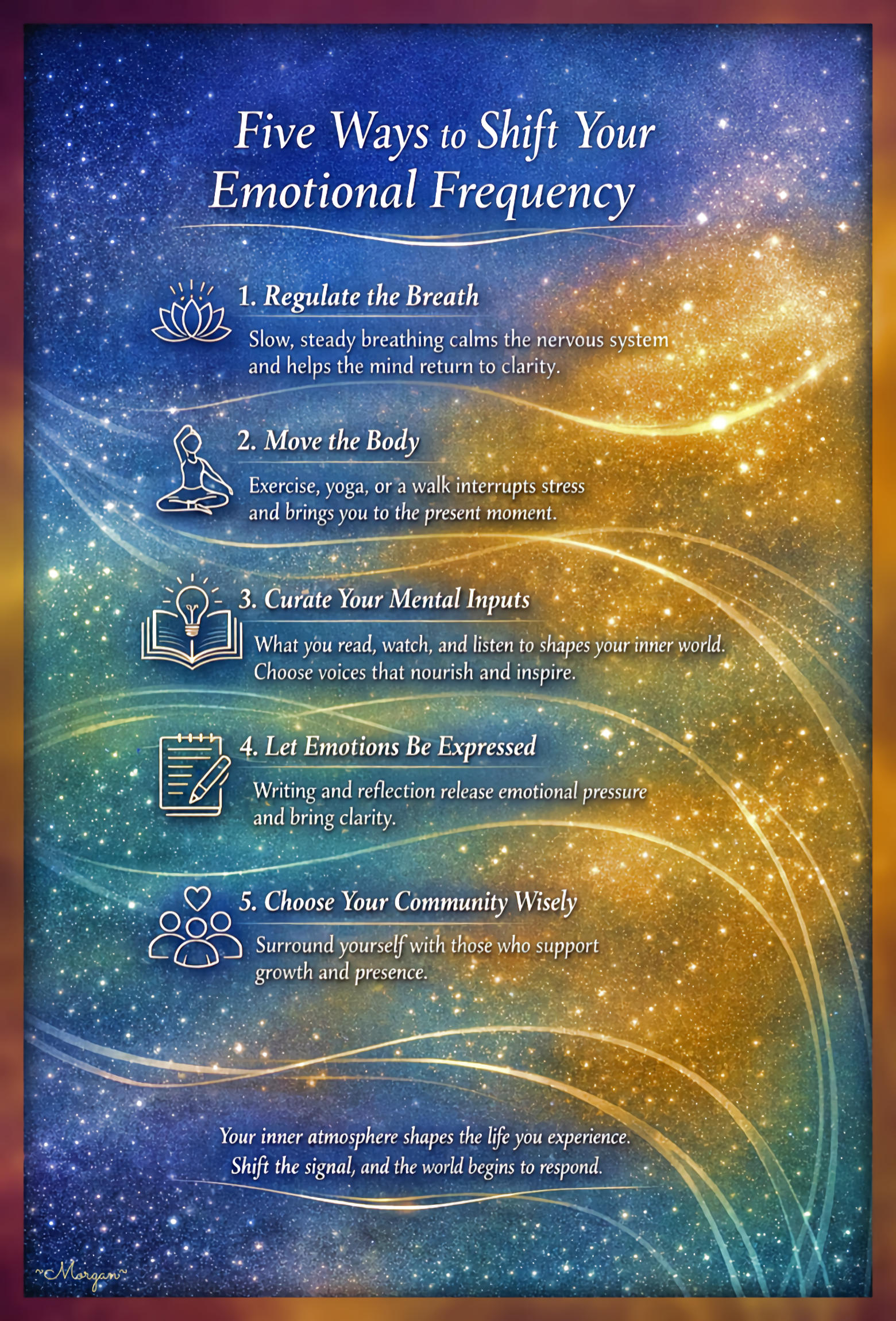
Five Ways to Shift Your Emotional Frequency
There are many ways to support this process, but a few practices consistently help regulate the nervous system and restore inner balance.
1. Regulate the Breath
Slow, steady breathing through the nose signals safety to the nervous system. When the breath becomes calm and rhythmic, the mind naturally follows. Even a few minutes of conscious breathing can gently shift the body out of stress and into coherence.
2. Move the Body
Physical movement helps release emotional stagnation. A demanding workout, a yoga practice, or even a simple walk can interrupt mental rumination and bring attention back into the present moment. Movement is often a form of meditation in motion.
3. Be Mindful of Mental Nutrition
Just as food influences the body, the information we consume influences the mind. The voices we listen to, the stories we read, the media we watch, and the conversations we participate in all shape our internal landscape. Choosing inputs that inspire and uplift can gradually transform our emotional baseline.
4. Give Emotions a Place to Land
Writing and journaling provide a powerful outlet for emotional processing. When thoughts and feelings are expressed rather than suppressed, their intensity often begins to soften. Clarity tends to emerge when we allow ourselves time to explore what we are truly feeling.
5. Choose Your Community Carefully
Human beings regulate one another emotionally. The people we spend the most time with inevitably influence our emotional state. Surrounding yourself with individuals who value honesty, compassion, and growth creates an environment where higher emotional states become easier to sustain.
The Quiet Power of Alignment
Raising your vibration does not mean becoming perfect, endlessly cheerful, or immune to life’s challenges.
It simply means becoming more available to life as it truly is, and learning how to return—again and again—to presence.
As this happens, something subtle begins to change.
The mind grows quieter.
The body softens.
Perception widens.
And the distance between the life we are living and the life we sense is possible often begins to shrink.
Because when the signal within us shifts, the world we interact with begins to respond.
Not all at once.
But steadily.
And sometimes in ways that feel quietly miraculous.

Join the Presence for Peace Event on Facebook
Subscribe to my YouTube Channel The Coherence Nexus
Find my artwork On DeviantArt
Subscribe to my Newsletter
~Morgan~
 BooknVolume
I believe that thoughts are extremely powerful. When I was going through a bad break up some years ago with a boyfriend who had many negative things to say, I started to internalize his insults. I began to believe that I was selfish because I spent so much time on my writing career. Then I started to listen to positive manifestations for sleep every night. Seeing my good. Knowing that I was a loving, kind, and yes hard-working individual. After some time I reset my thinking and realized that we just were not matched. Unfortunately, I have also discovered that most men do not like dating ambitious writers. But that’s another story…
LikeLiked by 1 person
It sounds like you made a healthy choice, which isn’t to say it was easy. Leaving behind relationships/situations that aren’t good for us is very often the first step in our Spiritual Journey. You WILL find someone who can support your work and not be threatened by it.
LikeLiked by 1 person
Thanks. It’s not easy out there!
LikeLike